Plant - plant interactions mediated by rhizosphere microbiota using the model : Arabidopsis thaliana (L.) Heynh - Phelipanche ramosa (L.) Pomel
| Responsables(s) : | Financement(s) : |
|---|---|

|
- Début du projet : 01/01/2025
- Fin du projet : 31/12/2026
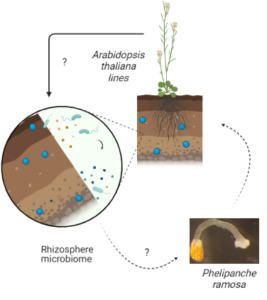
Embedded within the ANR-funded Plant2Mi project and selected among the 2025 nominees of the Joint Genome Institute (JGI) Community Science Program, this proposal aims to investigate how soil microbial communities influence interactions between parasitic broomrapes and their host plants. Using Arabidopsis thaliana, the parasitic broomrape Phelipanche ramosa, and agricultural soil as model systems, the project seeks to elucidate microbial contributions to parasitic plant seed germination and host-derived signaling processes.To disentangle the roles of specific host signaling pathways, the study compares wild-type A. thaliana plants with mutants impaired in strigolactone biosynthesis, strigolactone perception, or glucosinolate production.
The project includes a four-week kinetic sampling of A. thaliana root exudates using the miniaturized ExuFlow system. Exudate profiles from wild-type and mutant genotypes will be characterized through both untargeted metabolomics and targeted analyses of key signaling metabolites, including strigolactones, isothiocyanates, and glucosinolates.
In parallel, rhizosphere samples collected three weeks after plant transfer into the ExuFlow system are subjected to DNA and RNA extraction. These samples will be analysed by JGI-metagenomic analyses, combining long-read PacBio sequencing and Illumina MiSeq technologies, as well as prokaryotic metatranscriptomic profiling using Illumina sequencing.
By integrating metabolomic, metagenomic, and metatranscriptomic datasets across host genotypes, the project aims to identify microbial taxa and functions associated with host signaling pathways that regulate broomrape germination and plant–microbiome interactions.