Simulation of radiotherapy effect on prostate tumor control
| Responsables(s) : | Financement(s) : |
|---|---|

|
- Début du projet : 01/07/2023
- Fin du projet : 01/07/2030
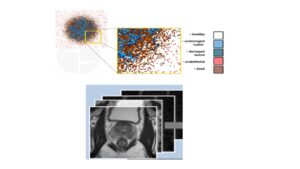
The project aims to develop a digital twin for patients diagnosed with prostate cancer to predict tumor progression and response to radiotherapy. By integrating multi-omic data (hypoxia, cell proliferation, gene expression) with mechanistic modeling, the digital twin will enable treatment optimization through in silico simulations that generate spatial distributions of surviving cells and synthetic images. A cooperation between the real and virtual worlds will be established to deliver patient-specific treatment. This personalized digital twin, based on a mechanistic model grounded in the radiobiology of tumor growth and radiation response, will address challenges related to model calibration for individual patients, observability, and the modeling of complex radiobiological mechanisms at different spatio-temporal scales for response prediction. To improve predictions of tumor evolution and recurrence and adapt radiotherapy, innovative data fusion approaches will be combined with new observables derived from advanced multiparametric MRI sequences, as well as microscopic-level histopathology and spatial transcriptomics.
The project will be carried out by teams with multidisciplinary and complementary expertise in imaging physics, histopathology, radiobiology, Monte Carlo simulation, medical physics, mechanistic modeling, artificial intelligence, and clinical practice. It leverages the expertise of the first two French centers equipped with the **Elekta Unity MRI-Linac (1.5T MRI)**, as well as unique platforms in France enabling high-precision adaptive radiotherapy. With significant expected impact, the project will advance medical physics, medical imaging, and AI. It will facilitate the design of personalized therapies and reduce healthcare costs by optimizing treatment for cancer patients.
Consortium: LTSI -Centre Eugène Marquis (O Acosta, R Decrevoisier), LATIM CHU Brest (J Bert), Inserm U1296 (N Foray), Eurecom (M Zuluaga), Institut de Cancérologie de l’Ouest- CNRS US2B (V Potiron, S Supiot)