Effect of proton Flash radiotherapy on the tumor microenvironment
| Responsables(s) : | Financement(s) : |
|---|---|

|
- Début du projet : 01/08/2026
- Fin du projet : 30/09/2029
Flash radiotherapy has emerged as a promising technique to increase the benefits/risk ratio in preclinical settings. Reduction of toxicity drives scientific consensus and has been demonstrated in various tissues (skin, intestines, brain, lungs) and models (mice, zebrafish, minipigs). However, the relative lack of tumor studies commends for accurately determining if anti-tumor efficacy and biological responses remain similar to conventional radiotherapy (RT). In particular, vascular and immunological effects are thought to influence RT outcomes but are incompletely understood. This is even more obvious for particular settings such as spatially fractionated RT (SFRT).
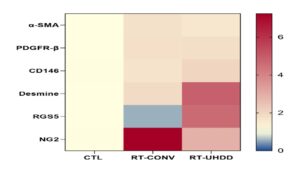
The project focuses on early (days-weeks) responses to radiation, determinant for therapeutic outcomes. Our hypothesis is that Flash-RT induces distinct vascular remodeling responses, which can later affect immune cell recruitment. Moreover, SFRT produces protected reservoirs within the tumor immune microenvironment, which would spare T-cells from radiation damage in shielded regions. Our objectives are to characterize the impact of FLASH and/or SFRT on pericyte profiles and cytokine release, to relate cancer cell outcomes to T-cell behaviors following irradiation, and to calibrate mathematical models with biological data to optimize SFRT parameters. We use microscopes coupled to a proton beam for live imaging of tumor cells co-cultured with T-cells.
We aim to enhance our understanding of cancer, vascular and immune cell responses to FLASH/SFRT. and expect that our data will support a new field of immuno-radiotherapy combination.
Consortium: Institut de Cancérologie de l’Ouest- CNRS US2B (V Potiron, S Supiot), Subatech CNRS IMT Atlantique (G Delpon, S Chiavassa), GIP Arronax (C Koumeir, F Haddad, N Servagent), Inserm U1232 Angers (P Vidi)