Effect of proton Flash radiotherapy on development, cerebral damage and vascularization
| Responsables(s) : | Financement(s) : |
|---|---|

|
- Début du projet : 01/09/2021
- Fin du projet : 01/09/2024
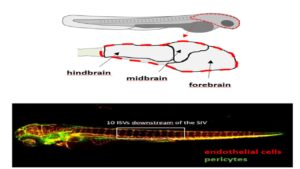
Brain tumors are the most frequent solid tumor in children and undergo radiotherapy (RT) in most of the cases. Brain tumor RT is routinely delivered using photons in most pediatric RT centers. However, proton therapy allows a more precise dose distribution and shows added value for reducing side-effects, although long-term debilitating effects can never be fully avoided. Further limiting the collateral damage of pediatric irradiation therefore remains a high-priority challenge. Flash irradiation has recently emerged as a promising modality with limited toxicity. It is carried out at ultra-high dose rates (« UHDR », > 40 Gy/sec), at least 200X those used in current practice. Combining both modalities to achieve UHDR proton radiotherapy appears as the gold bullet but requires specific and rare equipments. Using the cyclotron Arronax, we have demonstrated the superiority in protecting zebrafish embryo growth of UHDR proton RT. This enables to further study the vascular and neuronal effects of proton Flash RT in the juvenile brain. We are currently determining this biological response at the cellular and molecular level by in situ fluorescence of whole embryos and spatial transcriptomics.
Results indicate a protective effect of proton Flash RT in specific neuron progenitors, associated with reduced DNA damage and vascular remodeling. These data will define the optimal irradiation conditions for reducing side effects in child brain and the associated biological endpoints, paving the way for future robust clinical trials.
Consortium: Subatech CNRS IMT Atlantique (G Delpon, S Chiavassa), GIP Arronax (C Koumeir, F Haddad, N Servagent), Institut de Cancérologie de l’Ouest- CNRS US2B (V Potiron, S Supiot)
Chercheurs impliqués: Vincent Potiron, Stéphane Supiot