Etude fonctionnelle extra-hémostatique du facteur VIII de coagulation
| Responsables(s) : | Financement(s) : |
|---|---|
 |
- Début du projet : 02/07/2025
- Fin du projet : 01/07/2027
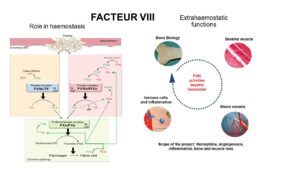
The most recurrent complications experienced by patients with haemophilia are recurrent bleeding episodes affecting joints and soft tissues, which ultimately contribute to abnormalities in angiogenesis, chronic inflammation, osteopenia, and sarcopenia. For decades, the associated bone and muscle loss was largely attributed to the prolonged sedentary lifestyle imposed by the disease. However, recent advances have revealed previously unrecognized extra-haemostatic functions of factor VIII (FVIII). FVIII deficiency has been associated with impaired bone remodelling, dysregulated macrophage polarization, persistent inflammatory responses, and the formation of structurally and functionally abnormal blood vessels with increased permeability. Collectively, these findings suggest that FVIII contributes to these clinical manifestations not only through its canonical role in haemostasis but also via extra-haemostatic functions, particularly in bone and skeletal muscle biology, vascular homeostasis, and inflammation (Cadé et al., Drug Discovery Today, 2022; Babuty et al, Bone Research, 2026).
The project aims:
– To better understand the function of FVIII in bone remodelling.
– To determine the contribution of FVIII in the biology of skeletal muscle.
– To decipher the functional